English Grammar: Modifier, Infinitive, Gerund, Participle, Tense, Sentence and Clause — BCS Cadre
English Grammar: Modifier, Infinitive, Gerund, Participle, Tense, Sentence and Clause: ইংরেজি, BCS Cadre পাঠ ও 401টি প্রশ্নের অনুশীলন। পৃষ্ঠা 1/9।
এ অধ্যায়ের পাঠ্যসূচী
- Modifier-এর ধারণা ও ব্যবহার
- Determiner: Noun নির্দিষ্ট করার শব্দ
- Article: a, an, the
- Quantifier ও Countability
- Intensifier ও Degree Modifier
- Noun Modifier ও Noun Adjective
- Appositive: ব্যাখ্যামূলক Noun Phrase
- Infinitive-এর মূল ধারণা ও শ্রেণি
- Full বা To-infinitive
- Continuous Infinitive
- Perfect Infinitive
- Perfect Continuous Infinitive
- Passive Infinitive
- Bare Infinitive: To ছাড়াই Verb
- Split Infinitive
- Gerund: Verb-ing-এর Noun কাজ
- Gerund ও Verbal Noun-এর পার্থক্য
- Participle: Verb-এর Adjectival ব্যবহার
- Present Participle
- Past Participle
- Perfect Participle
- Gerund, Participle ও Infinitive: দ্রুত শনাক্ত
- Tense: কাল ও Aspect-এর ধারণা
- Verb-এর V1, V2 ও V3
- Person, Number ও Subject-Verb Agreement
- Present Simple বা Indefinite
- Present Continuous
- Present Perfect
- Present Perfect Continuous
- Past Simple বা Indefinite
- Past Continuous
- Past Perfect
- No Sooner, Hardly ও Scarcely
- Past Perfect Continuous
- Future Simple
- Future Continuous
- Future Perfect
- Future Perfect Continuous
- Tense শনাক্তকরণের সমন্বিত কৌশল
- Mandative Subjunctive
- Sentence-এর অর্থ ও গঠন
- Simple Sentence
- Complex Sentence
- Compound Sentence
- Simple, Complex ও Compound তুলনা
- Phrase-এর ধারণা
- Clause-এর ধারণা
- Principal বা Main Clause
- Subordinate Clause
- Coordinate Clause
- Noun Clause
- Adjective বা Relative Clause
- Adverbial Clause
- Clause শনাক্ত করার নির্ভরযোগ্য পদ্ধতি
- BCS পরীক্ষায় প্রচলিত বিভ্রান্তি
- বহুনির্বাচনী প্রশ্নোত্তর
Modifier-এর ধারণা ও ব্যবহার
Understanding Modifiers
Modifier এমন শব্দ, শব্দগুচ্ছ বা clause যা অন্য কোনো পদের অর্থকে নির্দিষ্ট, সীমিত বা বিস্তৃত করে। সাধারণত adjective একটি noun বা pronoun সম্পর্কে অতিরিক্ত তথ্য দেয়; adverb একটি verb, adjective, adverb কিংবা পুরো বক্তব্যকে modify করতে পারে।
উদাহরণ: She bought a beautiful dress. এখানে beautiful শব্দটি dress-কে বর্ণনা করছে।
He speaks clearly. এখানে clearly ক্রিয়াটির ধরন জানাচ্ছে।
He is extremely careful. এখানে extremely বিশেষণের মাত্রা বোঝাচ্ছে।
পরীক্ষার কৌশল: প্রথমে modified word খুঁজে বের করুন, তারপর modifier-এর কাজ নির্ণয় করুন। এক??? শব্দ বিভিন্ন বাক্যে ভিন্ন কাজ করতে পারে।
Determiner: Noun নির্দিষ্ট করার শব্দ
Determiners
Noun phrase-এর শুরুতে বা অন্য modifier-এর আগে যে শব্দ কোনো ব্যক্তি বা বস্তুকে চিহ্নিত, নির্দিষ্ট কিংবা পরিমাণগতভাবে সীমাবদ্ধ করে, তাকে Determiner বলে। অধিকাংশ ক্ষেত্রে এটি noun-এর আগে বসে।
প্রধান শ্রেণি: Article (a, an, the), Demonstrative (this, that, these, those), Possessive (my, our, your, his, her, its, their), Interrogative (which, what, whose), Quantifier (some, many, much, few, little), Distributive (each, every, either, neither)।
উদাহরণ: Those students are ready. My friend lives here. Which road leads to the station?
বিশেষ পার্থক্য: This book belongs to her — this একটি determiner, কারণ এর পরে book আছে। This belongs to her — this pronoun-এর কাজ করছে। Modern grammar-এ determiner স্বতন্ত্র শ্রেণি; প্রচলিত পরীক্ষার বইয়ে কিছু determiner-কে adjective-ও বলা হয়।
Article: a, an, the
Articles as Determiners
A/An: সাধারণত একবচন গণনাযোগ্য noun-কে অনির্দিষ্টভাবে নির্দেশ করে। উচ্চারণের শুরুতে ব্যঞ্জনধ্বনি থাকলে a, স্বরধ্বনি থাকলে an ব্যবহৃত হয়।
উদাহরণ: a university, a European country, an hour, an honest person, an umbrella।
The: বক্তা ও শ্রোতার কাছে পরিচিত বা প্রসঙ্গ থেকে নির্দিষ্ট ব্যক্তি/বস্তু বোঝায়।
উদাহরণ: I saw a bird. The bird was injured.
ভুল এড়ান: Article ও Quantifier-এর কাজ এক নয়; a/an একক অনির্দিষ্ট noun phrase নির্দেশ করে, আর many/much পরিমাণ প্রকাশ করে।
Quantifier ও Countability
Quantifiers and Countable Nouns
Quantifier ব্যক্তি বা বস্তুর সংখ্যা ও পরিমাণ সম্পর্কে ধারণা দেয়। অনেক quantifier determiner হিসেবে ব্যবহৃত হয়।
Countable: many books, a few students, several chairs, fewer mistakes।
Uncountable: much water, a little patience, less sugar, a great deal of work।
উভয় ক্ষেত্রে: some, any, all, enough—প্রসঙ্গভেদে উভয় ধরনের noun-এর সঙ্গে ব্যবহার সম্ভব।
Few বনাম a few: few অর্থ প্রায় নেই—নেতিবাচক ইঙ্গিত; a few অর্থ কিছু আছে—ইতিবাচক ইঙ্গিত। Little বনাম a little একইভাবে অগণনযোগ্য noun-এর ক্ষেত্রে ব্যবহৃত হয়।
উদাহরণ: We have a few options. There is little time left.
পরীক্ষার কৌশল: শব্দটির পরে countable নাকি uncountable noun আছে তা আগে নির্ধারণ করুন।
Intensifier ও Degree Modifier
Intensifiers
Intensifier বিশেষণ, ক্রিয়াবিশেষণ বা কোনো বক্তব্যের তীব্রতা বাড়িয়ে বা জোর দিয়ে প্রকাশ করে।
উদাহরণ: She is very talented. He answered quite confidently. I really appreciate your help.
গুরুত্বপূর্ণ: very সরাসরি সাধারণত adjective/adverb-কে modify করে, কিন্তু really একটি verb phrase-ও modify করতে পারে। Indeed বাক্যের বক্তব্যের প্রতি জোর নির্দেশ করতে পারে।
পরীক্ষার কৌশল: intensifier কোন শব্দকে modify করেছে সেটিই তার কার্য নির্ণয়ের মূল উপায়।
Noun Modifier ও Noun Adjective
Noun as Modifier
একটি noun আরেকটি noun-এর আগে বসে তার ধরন, উদ্দেশ্য বা সম্পর্ক নির্দেশ করতে পারে; একে noun modifier বা attributive noun বলা হয়।
উদাহরণ: a school bus, a government office, a coffee cup, an English grammar book।
School bus-এ school নিজে noun হলেও bus-এর প্রকৃতি নির্ধারণ করছে। English একটি proper adjective, কিন্তু government একটি noun modifier।
ভুল এড়ান: বিশেষণের কাজ করলেই শব্দটির lexical class বদলে adjective হয়ে যায়—এমন নয়।
Appositive: ব্যাখ্যামূলক Noun Phrase
Appositive
কোনো noun বা pronoun-এর পরিচয় নতুন করে ব্যাখ্যা করার জন্য তার পাশে বসা noun phrase-কে appositive বলা হয়।
উদাহরণ: Mr Karim, our mathematics teacher, gave us useful advice.
এখানে our mathematics teacher অংশটি Mr Karim সম্পর্কে পরিচয় দিচ্ছে। অতিরিক্ত, অপরিহার্য নয় এমন appositive কমা দিয়ে আলাদা করা হয়।
Restrictive: My friend Rafi called yesterday — পরিচয় নির্ধারণে নামটি প্রয়োজন হতে পারে, তাই কমা নাও থাকতে পারে।
Infinitive-এর মূল ধারণা ও শ্রেণি
Introduction to Infinitives
Infinitive হলো verb-এর non-finite রূপ। সাধারণত to-এর পরে verb-এর base form ব্যবহৃত হয়; তবে কিছু পরিবেশে to ছাড়াও base form আসে।
উদাহরণ: They hope to succeed. We can succeed.
প্রধান রূপ: To-infinitive বা Full Infinitive, Bare Infinitive এবং to ও verb-এর মাঝখানে modifier-যুক্ত Split Infinitive।
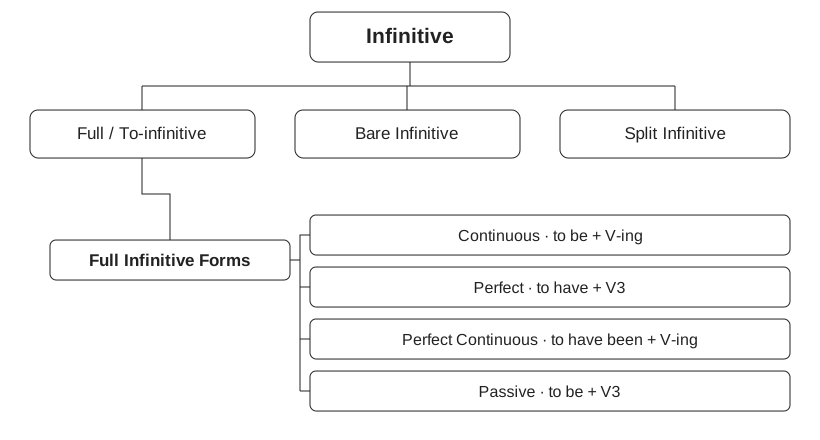
উদাহরণ: They hope to succeed. We can succeed.
প্রধান রূপ: To-infinitive বা Full Infinitive, Bare Infinitive এবং to ও verb-এর মাঝখানে modifier-যুক্ত Split Infinitive।
Full বা To-infinitive
Full Infinitive
To + base verb ব্যবহার করে Full Infinitive গঠিত হয়। এটি subject, object, complement কিংবা modifier হিসেবে কাজ করতে পারে।
Subject: To read regularly improves vocabulary.
Object: She wants to join the course.
Subject Complement: His ambition is to become a doctor.
Purpose: He saved money to buy a laptop.
Noun modifier: I have some tasks to finish.
পরীক্ষার কৌশল: To-এর পরের শব্দ সব সময় infinitive নয়—She went to school বাক্যে to preposition।
Continuous Infinitive
Continuous Infinitive
গঠন: to be + verb-ing। এটি কোনো নির্দিষ্ট সময়ে চলমান কাজের ধারণা দেয়।
উদাহরণ: The children seem to be enjoying the trip.
He appeared to be waiting for someone.
Modal construction: She might be studying এখনকার সম্ভাব্য চলমান কাজ বোঝায়; এখানে might-এর পর be হলো bare infinitive-এর অংশ, পুরো might be studying-কে প্রচলিত অর্থে full infinitive বলা ঠিক নয়।
উদাহরণ: The children seem to be enjoying the trip.
He appeared to be waiting for someone.
Modal construction: She might be studying এখনকার সম্ভাব্য চলমান কাজ বোঝায়; এখানে might-এর পর be হলো bare infinitive-এর অংশ, পুরো might be studying-কে প্রচলিত অর্থে full infinitive বলা ঠিক নয়।
Perfect Infinitive
Perfect Infinitive
গঠন: to have + past participle। মূল verb দ্বারা নির্দেশিত সময়ের আগেই কোনো কাজ সংঘটিত হয়েছে এমন অর্থ প্রকাশ করে।
উদাহরণ: He seems to have forgotten the address.
She claimed to have completed the assignment.
Modal perfect: He must have left — এখানে must-এর পরে have হলো bare infinitive; পরবর্তী অংশ অতীত সম্পর্কে অনুমান জানায়।
উদাহরণ: He seems to have forgotten the address.
She claimed to have completed the assignment.
Modal perfect: He must have left — এখানে must-এর পরে have হলো bare infinitive; পরবর্তী অংশ অতীত সম্পর্কে অনুমান জানায়।
Perfect Continuous Infinitive
Perfect Continuous Infinitive
গঠন: to have been + verb-ing। কোনো পূর্ববর্তী সময় থেকে চলতে থাকা কাজের ধারণা দেয়।
উদাহরণ: She seems to have been working all night.
They claimed to have been waiting for hours.
তুলনা: to have written — কাজ সম্পন্ন হওয়ার ওপর জোর; to have been writing — কাজের ধারাবাহিকতার ওপর জোর।
উদাহরণ: She seems to have been working all night.
They claimed to have been waiting for hours.
তুলনা: to have written — কাজ সম্পন্ন হওয়ার ওপর জোর; to have been writing — কাজের ধারাবাহিকতার ওপর জোর।
Passive Infinitive
Passive Infinitive
গঠন: to be + past participle। Infinitive-এর subject কাজটি নিজে না করে কাজটির প্রাপক হলে passive infinitive ব্যবহৃত হতে পারে।
উদাহরণ: She hopes to be selected for the team.
This room needs to be cleaned.
Perfect passive: to have been + past participle; যেমন He is believed to have been appointed last year।
Modal passive: The form must be submitted — এখানে must-এর পরে be base form-এ থাকে।
উদাহরণ: She hopes to be selected for the team.
This room needs to be cleaned.
Perfect passive: to have been + past participle; যেমন He is believed to have been appointed last year।
Modal passive: The form must be submitted — এখানে must-এর পরে be base form-এ থাকে।
Bare Infinitive: To ছাড়াই Verb
Bare Infinitive
Bare Infinitive হচ্ছে to ছাড়া verb-এর base form।
Modal-এর পরে: can go, may leave, must study, should work, will come।
Had better / would rather: You had better rest. I would rather stay.
Let / make / have: Let him try. They made us wait. I had the mechanic check the engine.
Perception verbs: I saw him cross the road; I heard her sing.
Why প্রশ্নে: Why worry about it?
ভুল এড়ান: Passive-এ make-এর পর সাধারণত to ফিরে আসে: We were made to wait. Help-এর পরে bare অথবা to-infinitive উভয় রূপই সম্ভব।
Split Infinitive
Split Infinitive
To এবং verb-এর base form-এর মাঝখানে adverb বা অন্য modifier থাকলে split infinitive সৃষ্টি হয়।
উদাহরণ: She decided to carefully review the report.
The team plans to gradually improve its performance.
ব্যবহার: আধুনিক ইংরেজিতে split infinitive গ্রহণযোগ্য; প্রয়োজন হলে বাক্যের স্বাভাবিকতা ও অর্থের স্পষ্টতা বজায় রেখে ব্যবহার করা যায়।
উদাহরণ: She decided to carefully review the report.
The team plans to gradually improve its performance.
ব্যবহার: আধুনিক ইংরেজিতে split infinitive গ্রহণযোগ্য; প্রয়োজন হলে বাক্যের স্বাভাবিকতা ও অর্থের স্পষ্টতা বজায় রেখে ব্যবহার করা যায়।
Gerund: Verb-ing-এর Noun কাজ
Gerund
Verb-এর ing রূপ যখন noun phrase-এর কেন্দ্র হিসেবে subject, object বা preposition-এর complement হয়, তখন তাকে Gerund বা gerund-participial construction-এর nominal use বলা হয়।
Subject: Swimming is a healthy activity.
Object: She enjoys painting.
After preposition: He is interested in learning Spanish.
After certain verbs: avoid, enjoy, finish, consider, suggest, mind, practise ইত্যাদির পরে সাধারণত ing form ব্যবহৃত হয়।
পরীক্ষার কৌশল: শুধু ing দেখেই সিদ্ধান্ত নয়; অংশটির বাক্যগত কাজ খুঁজতে হবে।
Gerund ও Verbal Noun-এর পার্থক্য
Gerund versus Verbal Noun
Traditional grammar-এ verbal noun একটি noun হিসেবে বেশি স্বাধীনভাবে আচরণ করে: তার আগে article বা adjective এবং পরে of-phrase থাকতে পারে।
Gerund: Reading books broadens the mind.
Verbal noun: The careful reading of the books took several days.
Gerund-এর সঙ্গে সরাসরি object আসতে পারে; verbal noun-এ অনেক ক্ষেত্রে of ব্যবহৃত হয়।
সতর্কতা: The reading of the letter-এ reading noun; reading the letter-এ reading verbal construction।
Gerund: Reading books broadens the mind.
Verbal noun: The careful reading of the books took several days.
Gerund-এর সঙ্গে সরাসরি object আসতে পারে; verbal noun-এ অনেক ক্ষেত্রে of ব্যবহৃত হয়।
সতর্কতা: The reading of the letter-এ reading noun; reading the letter-এ reading verbal construction।
Participle: Verb-এর Adjectival ব্যবহার
Participles
Participle verb-derived এমন রূপ যা adjective-এর মতো কাজ করতে পারে বা verb phrase গঠনে ব্যবহৃত হয়। প্রচলিত শ্রেণিবিভাগে Present Participle, Past Participle ও Perfect Participle আলোচনা করা হয়।
Present: The crying baby needs attention.
Past: The broken window was repaired.
Perfect: Having finished the test, she left the room.
বিশেষ: participle-এর অর্থ সময়ের সঙ্গে সব সময় সরাসরি এক নয়। Form ও function আলাদা করে চিনতে হবে।
Present: The crying baby needs attention.
Past: The broken window was repaired.
Perfect: Having finished the test, she left the room.
বিশেষ: participle-এর অর্থ সময়ের সঙ্গে সব সময় সরাসরি এক নয়। Form ও function আলাদা করে চিনতে হবে।
Present Participle
Present Participle
Verb-ing form noun-এর বৈশিষ্ট্য বা কোনো চলমান ঘটনার ধারণা প্রকাশ করতে পারে।
উদাহরণ: A glowing lamp lit the room.
The story was interesting.
He is working — এখানে working progressive verb phrase-এর অংশ; পৃথক adjective নয়।
Gerund থেকে পার্থক্য: Running is enjoyable — subject হিসেবে gerund; a running engine — noun modifier হিসেবে participle।
উদাহরণ: A glowing lamp lit the room.
The story was interesting.
He is working — এখানে working progressive verb phrase-এর অংশ; পৃথক adjective নয়।
Gerund থেকে পার্থক্য: Running is enjoyable — subject হিসেবে gerund; a running engine — noun modifier হিসেবে participle।
Past Participle
Past Participle
Regular verb-এর ক্ষেত্রে সাধারণত -ed এবং irregular verb-এর ক্ষেত্রে ভিন্ন রূপ হয়: written, built, broken, seen, taken ইত্যাদি।
Adjective: a damaged bridge, boiled water।
Perfect construction: She has written the letter.
Passive construction: The letter was written yesterday.
পরীক্ষার কৌশল: has/have/had-এর পর V3 perfect construction; be-এর সঙ্গে V3 সাধারণত passive অথবা adjectival অর্থে ব্যবহৃত হতে পারে।
Adjective: a damaged bridge, boiled water।
Perfect construction: She has written the letter.
Passive construction: The letter was written yesterday.
পরীক্ষার কৌশল: has/have/had-এর পর V3 perfect construction; be-এর সঙ্গে V3 সাধারণত passive অথবা adjectival অর্থে ব্যবহৃত হতে পারে।
Perfect Participle
Perfect Participle
Active form: having + past participle। প্রধান clause-এর ঘটনার আগেই কোনো কাজ শেষ হওয়ার ধারণা দেয়।
উদাহরণ: Having completed her research, she submitted the paper.
Passive form: having been + past participle। যেমন Having been warned, they took precautions.
সতর্কতা: Participial phrase-এর implied subject মূল clause-এর subject-এর সঙ্গে যৌক্তিকভাবে মিলতে হবে।
উদাহরণ: Having completed her research, she submitted the paper.
Passive form: having been + past participle। যেমন Having been warned, they took precautions.
সতর্কতা: Participial phrase-এর implied subject মূল clause-এর subject-এর সঙ্গে যৌক্তিকভাবে মিলতে হবে।
Gerund, Participle ও Infinitive: দ্রুত শনাক্ত
Gerund, Participle and Infinitive Compared
Gerund: Writing improves communication. এখানে writing subject।
Participle: The writing student looked focused. এখানে writing student-কে modify করছে।
Infinitive: She wishes to write a novel. এখানে to write একটি complement।
অতিরিক্ত অনুশীলন: I saw him running — running বাক্যে object-এর সঙ্গে যুক্ত participial complement। I enjoy running — running object/complement হিসেবে nominal role-এ।
Tense: কাল ও Aspect-এর ধারণা
Tense and Aspect
ঘটনার সময় এবং কাজের প্রকৃতি বোঝাতে verb-এর form ও auxiliary ব্যবহৃত হয়। পরীক্ষার প্রচলিত পাঠ্যক্রমে Present, Past ও Future—প্রতিটির Simple, Continuous, Perfect এবং Perfect Continuous রূপ নিয়ে মোট ১২টি tense pattern পড়ানো হয়।
Simple: অভ্যাস, সাধারণ ঘটনা বা সম্পূর্ণ ঘটনা।
Continuous: নির্দিষ্ট সময়ে চলমান কাজ।
Perfect: একটি reference time-এর তুলনায় পূর্ববর্তী কাজ বা তার ফল।
Perfect Continuous: নির্দিষ্ট সময় পর্যন্ত কাজের ধারাবাহিকতা।
বিশেষ: Modern linguistic analysis-এ will-যুক্ত ভবিষ্যৎ গঠনকে grammatical tense-এর বদলে modal future construction হিসেবেও ব্যাখ্যা করা হয়; তবে BCS preparation-এ প্রচলিত ১২টি pattern জানাই কার্যকর।
Verb-এর V1, V2 ও V3
Principal Forms of Verbs
Verb-এর base form, past form ও past participle বিভিন্ন tense এবং voice গঠনে ব্যবহৃত হয়।
উদাহরণ: go – went – gone; write – wrote – written; do – did – done; eat – ate – eaten; play – played – played।
V1: I write every morning.
V2: I wrote yesterday.
V3: I have written three pages.
মনে রাখুন: V3 শুধু perfect-এ নয়, passive-এও ব্যবহৃত হয়: The letter was written. V2 সাধারণত simple past-এর মূল verb।
Person, Number ও Subject-Verb Agreement
Person and Agreement
First person: I, we; Second person: you; Third person: he, she, it, they এবং অন্যান্য noun phrase।
Present simple-এ third-person singular subject-এর পরে মূল verb-এ সাধারণত s বা es যুক্ত হয়: He works; They work।
Be: I am; he/she/it is; you/we/they are। অতীতে I/he/she/it was; you/we/they were।
Have: he has; I/you/we/they have।
বিশেষ: you একবচন ও বহুবচন—দুই ক্ষেত্রেই are গ্রহণ করে।
ভুল এড়ান: Does/Did-এর পরে মূল verb base form-এ: Does he work? He did not go.
Present Simple বা Indefinite
Present Simple
গঠন: Subject + V1; third-person singular-এর ক্ষেত্রে V1+s/es।
ব্যবহার: অভ্যাস, নিয়মিত কাজ, সাধারণ সত্য, স্থায়ী অবস্থা ও নির্ধারিত সময়সূচি।
উদাহরণ: She reads every evening. Water boils at standard pressure near 100°C. The train leaves at six.
Signal words: usually, often, regularly, sometimes, every day, seldom।
Negative: He does not play. Question: Do they work here?
সতর্কতা: frequency adverb থাকলেই সবসময় present simple হবে এমন নয়; সম্পূর্ণ প্রসঙ্গ দেখতে হবে।
Present Continuous
Present Continuous
গঠন: am/is/are + verb-ing।
ব্যবহার: কথা বলার মুহূর্তে চলমান কাজ, সাময়িক পরিস্থিতি, পরিবর্তনশীল প্রবণতা অথবা পূর্বনির্ধারিত ভবিষ্যৎ পরিকল্পনা।
উদাহরণ: I am preparing for the exam. Prices are rising. We are meeting tomorrow.
Signal words: now, at the moment, currently, still।
বিশেষ: know, believe, own-এর মতো অনেক stative verb সাধারণ অর্থে progressive-এ কম ব্যবহৃত হয়। তবে কোনো কোনো verb বিশেষ অর্থে continuous হতে পারে।
Present Perfect
Present Perfect
গঠন: have/has + V3।
ব্যবহার: অতীতের কাজের বর্তমান প্রাসঙ্গিকতা, বর্তমান পর্যন্ত অভিজ্ঞতা, বা এখনো শেষ হয়নি এমন সময়সীমায় সংঘটিত ঘটনা।
উদাহরণ: I have finished the report. She has visited Sylhet twice. We have known him for years.
সাধারণ সংকেত: already, just, yet, ever, never, so far, recently, since, for।
ভুল এড়ান: নির্দিষ্ট সমাপ্ত অতীত সময়ের সঙ্গে সাধারণত simple past: I visited him yesterday — I have visited him yesterday নয়। Just now সাধারণত simple past-এর সঙ্গে বেশি স্বাভাবিক: He left just now।
Present Perfect Continuous
Present Perfect Continuous
গঠন: have/has been + verb-ing।
ব্যবহার: অতীতে শুরু হওয়া কাজ এখনো চলছে অথবা সদ্য শেষ হয়েছে কিন্তু তার প্রভাব বর্তমান।
উদাহরণ: They have been studying since morning. I have been waiting for half an hour.
Since: starting point — since Monday, since 2020, since dawn।
For: duration — for two hours, for six months, for a long time।
বিশেষ: since এবং for শুধু নির্দিষ্ট একটি tense-এ সীমাবদ্ধ নয়। Stative verb-এর ক্ষেত্রে অনেক সময় present perfect বেশি স্বাভাবিক: I have known her for years।
Past Simple বা Indefinite
Past Simple
গঠন: Subject + V2। Negative/Question-এ did + base form।
ব্যবহার: অতীতে নির্দিষ্ট বা সম্পূর্ণ ঘটনা, ধারাবাহিক অতীত কাজ, আগের অভ্যাস।
উদাহরণ: They arrived yesterday. He opened the door, entered and sat down.
Signal words: yesterday, last week, two years ago, in 2015।
Negative: She did not come. Question: Did he call?
ব্যবহার: অতীতে নির্দিষ্ট বা সম্পূর্ণ ঘটনা, ধারাবাহিক অতীত কাজ, আগের অভ্যাস।
উদাহরণ: They arrived yesterday. He opened the door, entered and sat down.
Signal words: yesterday, last week, two years ago, in 2015।
Negative: She did not come. Question: Did he call?
Past Continuous
Past Continuous
গঠন: was/were + verb-ing।
ব্যবহার: অতীতে কোনো নির্দিষ্ট মুহূর্তে চলমান কাজ, আরেক ঘটনার প্রেক্ষাপট বা সমান্তরাল চলমান কার্যক্রম।
উদাহরণ: At eight last night, we were discussing the plan.
I was reading when the phone rang.
While she was cooking, he was setting the table.
Signal words: at that time, while, at that moment—তবে সংকেত নয়, সময়গত অর্থই সিদ্ধান্তের ভিত্তি।
Past Perfect
Past Perfect
গঠন: had + V3।
ব্যবহার: অতীতের আরেকটি সময় বা ঘটনার আগেই কোনো কাজ সম্পন্ন হয়েছিল তা বোঝায়।
উদাহরণ: The bus had left before we reached the stop.
By the time she arrived, the meeting had started.
Before/After: Earlier event নির্দেশ করতে past perfect কার্যকর; তবে ঘটনাক্রম পরিষ্কার থাকলে উভয় clause-এ past simple-ও গ্রহণযোগ্য হতে পারে।
ভুল এড়ান: প্রতিটি before বা after দেখেই বাধ্যতামূলক past perfect বসাবেন না।
No Sooner, Hardly ও Scarcely
Inversion with Time Expressions
প্রথম ঘটনা শেষ হওয়ার সঙ্গে সঙ্গেই আরেকটি ঘটনা ঘটলে এই গঠনগুলো ব্যবহৃত হয়।
No sooner: No sooner had we entered the hall than the lights went out.
Hardly: Hardly had he sat down when the bell rang.
Scarcely: Scarcely had she started when it began to rain.
পরীক্ষার সূত্র: বাক্যের শুরুতে negative/restrictive adverbial থাকায় auxiliary–subject inversion হয়। Common pairing: no sooner…than; hardly/scarcely…when।
Past Perfect Continuous
Past Perfect Continuous
গঠন: had been + verb-ing।
ব্যবহার: অতীতে কোনো নির্দিষ্ট সময়ের আগে থেকে চলমান কাজের স্থায়িত্ব প্রকাশ।
উদাহরণ: They had been practising for months before the tournament began.
She was exhausted because she had been working all day.
তুলনা: had completed কাজ সম্পন্ন হওয়ায় জোর দেয়, আর had been completing স্বাভাবিক প্রসঙ্গে চলমানতার ওপর জোর দিলেও সব verb-এর সঙ্গে স্বাভাবিক নয়।
Future Simple
Future Simple
গঠন: will + base form। Traditional English-এ কিছু প্রসঙ্গে I/we-এর সঙ্গে shall ব্যবহৃত হলেও আধুনিক সাধারণ ইংরেজিতে will সব subject-এর সঙ্গেই স্বাভাবিক।
ব্যবহার: ভবিষ্যৎ সিদ্ধান্ত, পূর্বাভাস, প্রতিশ্রুতি, সম্ভাবনা।
উদাহরণ: I will call you tomorrow. They will complete the project next week.
বিশেষ: পরিকল্পনা বোঝাতে be going to বা present continuous-ও হতে পারে: We are going to travel next month।
ব্যবহার: ভবিষ্যৎ সিদ্ধান্ত, পূর্বাভাস, প্রতিশ্রুতি, সম্ভাবনা।
উদাহরণ: I will call you tomorrow. They will complete the project next week.
বিশেষ: পরিকল্পনা বোঝাতে be going to বা present continuous-ও হতে পারে: We are going to travel next month।
Future Continuous
Future Continuous
গঠন: will be + verb-ing।
ব্যবহার: ভবিষ্যতের নির্দিষ্ট সময়ে কাজটি চলমান থাকবে।
উদাহরণ: This time tomorrow, she will be travelling.
At nine tonight, we will be watching the match.
সতর্কতা: At this time কথাটি একা tense নির্ধারণ করে না; প্রসঙ্গে ভবিষ্যৎ, বর্তমান বা অতীত বোঝানো হতে পারে।
ব্যবহার: ভবিষ্যতের নির্দিষ্ট সময়ে কাজটি চলমান থাকবে।
উদাহরণ: This time tomorrow, she will be travelling.
At nine tonight, we will be watching the match.
সতর্কতা: At this time কথাটি একা tense নির্ধারণ করে না; প্রসঙ্গে ভবিষ্যৎ, বর্তমান বা অতীত বোঝানো হতে পারে।
Future Perfect
Future Perfect
গঠন: will have + V3।
ব্যবহার: ভবিষ্যতের নির্দিষ্ট সময়সীমা বা অন্য ঘটনার আগে কাজ শেষ হয়ে যাবে।
উদাহরণ: By Friday, we will have submitted the form.
By the time you arrive, the guests will have left.
সময়-উপবাক্য: after, before, when, by the time-এর future-reference subordinate clause-এ সাধারণত present simple হয়: before he comes, not before he will come।
Future Perfect Continuous
Future Perfect Continuous
গঠন: will have been + verb-ing।
ব্যবহার: ভবিষ্যতের নির্দিষ্ট সময় পর্যন্ত একটি কাজ কতক্ষণ ধরে চলতে থাকবে তা প্রকাশ।
উদাহরণ: By next June, she will have been teaching for ten years.
At noon, they will have been travelling for six hours.
সতর্কতা: এই গঠন অপেক্ষাকৃত কম ব্যবহৃত হলেও ব্যাকরণগতভাবে সঠিক এবং BCS পরীক্ষার জন্য গুরুত্বপূর্ণ।
Tense শনাক্তকরণের সমন্বিত কৌশল
Tense Selection Strategy
১। কাজের সময় নির্ধারণ করুন—বর্তমান, সমাপ্ত অতীত, নাকি ভবিষ্যৎ reference point।
২। কাজটি অভ্যাসগত, চলমান, সম্পন্ন, নাকি দীর্ঘসময় ধরে চলমান তা খুঁজুন।
৩। Auxiliary চিহ্নিত করুন—be + ing, have + V3, have been + ing।
৪। Time expression-কে সহায়ক সংকেত ধরুন, চূড়ান্ত নিয়ম নয়।
৫। আগে-পরে দুই ঘটনার ক্ষেত্রে ঘটনাক্রম ও প্রসঙ্গ দেখুন।
তুলনা: I work here (নিয়মিত); I am working here (সাময়িক/এখন); I have worked here (এ পর্যন্ত অভিজ্ঞতা); I have been working here since January (সময় ধরে চলমান)।
Mandative Subjunctive
Subjunctive after Demand and Requirement
Demand, recommend, require, insist, suggest-এর মতো verb-এর পরে formal English-এ that-clause-এর finite verb base form-এ আসতে পারে।
উদাহরণ: The committee recommended that every member attend the meeting.
The university requires that each student complete the course.
British alternative: should attend / should complete—প্রসঙ্গভেদে গ্রহণযোগ্য।
ভুল এড়ান: Singular subject হলেও mandative subjunctive-এ attends নয়, attend।
উদাহরণ: The committee recommended that every member attend the meeting.
The university requires that each student complete the course.
British alternative: should attend / should complete—প্রসঙ্গভেদে গ্রহণযোগ্য।
ভুল এড়ান: Singular subject হলেও mandative subjunctive-এ attends নয়, attend।
Sentence-এর অর্থ ও গঠন
Sentences
পূর্ণাঙ্গ অর্থ প্রকাশকারী স্বাধীন grammatical structure-কে Sentence বলা হয়। Traditional exam grammar-এ বাক্যকে গঠনগতভাবে তিন ভাগে পড়ানো হয়—Simple, Complex ও Compound।
মূল উপাদান: Subject, finite verb phrase এবং প্রয়োজনমতো object, complement, adjunct।
উদাহরণ: The children laughed. She bought a notebook. The sky became dark.
মনে রাখুন: সব sentence-এ overt subject বাধ্যতামূলক নয়; imperative বাক্যে implied you থাকে: Come here।
মূল উপাদান: Subject, finite verb phrase এবং প্রয়োজনমতো object, complement, adjunct।
উদাহরণ: The children laughed. She bought a notebook. The sky became dark.
মনে রাখুন: সব sentence-এ overt subject বাধ্যতামূলক নয়; imperative বাক্যে implied you থাকে: Come here।
Simple Sentence
Simple Sentence
Simple Sentence-এ সাধারণত একটি স্বাধীন clause থাকে; একটি মাত্র finite verb থাকতেই হবে—এমন নয়, কারণ compound predicate-এ একাধিক finite verb একই clause-এর অংশ হতে পারে।
উদাহরণ: She reads novels.
He opened the window and looked outside. — একই subject-এর দুই coordinated predicates; এটিকে simple sentence হিসেবে বিশ্লেষণ করা যায়।
Non-finite phrase: To improve his English, he practises daily — to improve clause non-finite, বাক্যের মূল finite clause একটি।
Because of / despite / in spite of: এদের পরে noun বা ing phrase বসলে আলাদা finite subordinate clause না-ও তৈরি হতে পারে।
Complex Sentence
Complex Sentence
Complex Sentence-এ অন্তত একটি independent clause এবং একটি subordinate/dependent clause থাকে। Subordinate clause noun, adjective বা adverbial function পালন করতে পারে।
উদাহরণ: I met the woman who designed the bridge.
Although it was late, they continued studying.
She believes that the result will improve.
ভুল এড়ান: Relative word-ই একমাত্র subordinate marker নয়; because, although, if, when, that—সবই প্রসঙ্গভেদে clause introduce করতে পারে।
উদাহরণ: I met the woman who designed the bridge.
Although it was late, they continued studying.
She believes that the result will improve.
ভুল এড়ান: Relative word-ই একমাত্র subordinate marker নয়; because, although, if, when, that—সবই প্রসঙ্গভেদে clause introduce করতে পারে।
Compound Sentence
Compound Sentence
দুই বা ততোধিক independent clause সমন্বয়কারী conjunction বা উপযুক্ত punctuation-এ যুক্ত হলে compound sentence হয়।
উদাহরণ: I wanted to leave, but the rain continued.
She called me, and I answered immediately.
FANBOYS: for, and, nor, but, or, yet, so।
বিশেষ: and বা but থাকলেই compound নয়; এটি দুটি শব্দ বা phrase-ও যুক্ত করতে পারে: tea and coffee। Independent clause দুটো আছে কি না দেখতে হবে।
উদাহরণ: I wanted to leave, but the rain continued.
She called me, and I answered immediately.
FANBOYS: for, and, nor, but, or, yet, so।
বিশেষ: and বা but থাকলেই compound নয়; এটি দুটি শব্দ বা phrase-ও যুক্ত করতে পারে: tea and coffee। Independent clause দুটো আছে কি না দেখতে হবে।
Simple, Complex ও Compound তুলনা
Comparison of Sentence Structures
Simple: Because of heavy rain, the game stopped.
Complex: The game stopped because it rained heavily.
Compound: It rained heavily, so the game stopped.
আরও একটি সেট:
Simple — Despite his illness, he attended the class.
Complex — Although he was ill, he attended the class.
Compound — He was ill, yet he attended the class.
পরীক্ষার সূত্র: Because of/Despite/In spite of প্রায়ই preposition; because/although/though finite clause introduce করে।
Phrase-এর ধারণা
Phrases
Phrase হলো clause-এর তুলনায় ছোট বা আলাদা grammatical unit, যার head noun, verb, adjective, adverb বা preposition হতে পারে। Phrase নিজের মধ্যে finite subject–predicate সম্পর্ক থাকা বাধ্যতামূলক নয়।
Noun phrase: a very old library।
Prepositional phrase: near the school।
Adjective phrase: extremely proud of her result।
Adverb phrase: quite slowly।
Verb phrase: has been writing।
তুলনা: after the ceremony — prepositional phrase; after the ceremony ended — একটি subordinate finite clause যুক্ত construction।
Clause-এর ধারণা
Clauses
Clause এমন grammatical unit যেখানে subject-predicate সম্পর্ক থাকতে পারে; finite clause-এ finite verb থাকে। Modern grammar-এ non-finite clause-ও স্বীকৃত, যেমন to leave early।
Independent: The class has started.
Dependent: because the teacher arrived।
সমন্বিত: The class started when the teacher arrived.
ব্যাখ্যা: স্বাধীন clause নিজে statement হিসেবে দাঁড়াতে পারে; dependent clause সাধারণত অন্য অংশের সঙ্গে সম্পর্কিত।
Independent: The class has started.
Dependent: because the teacher arrived।
সমন্বিত: The class started when the teacher arrived.
ব্যাখ্যা: স্বাধীন clause নিজে statement হিসেবে দাঁড়াতে পারে; dependent clause সাধারণত অন্য অংশের সঙ্গে সম্পর্কিত।
Principal বা Main Clause
Main Clause
Complex sentence-এর স্বাধীন অংশটি Main/Principal Clause। এটি একা অর্থবহ বক্তব্য গঠন করতে পারে।
উদাহরণ: I shall wait until you return.
Main Clause — I shall wait। Dependent adverbial clause — until you return।
বিশেষ: সব complex sentence-এর main clause-কে বাক্যের শুরুতেই থাকতে হবে এমন নয়: When you return, I shall wait outside।
উদাহরণ: I shall wait until you return.
Main Clause — I shall wait। Dependent adverbial clause — until you return।
বিশেষ: সব complex sentence-এর main clause-কে বাক্যের শুরুতেই থাকতে হবে এমন নয়: When you return, I shall wait outside।
Subordinate Clause
Subordinate Clause
Subordinate clause প্রধান clause-এর সঙ্গে অর্থগত বা ব্যাকরণগত নির্ভরতায় যুক্ত থাকে। প্রচলিত পরীক্ষার শ্রেণিবিভাগে তিনটি প্রধান কার্যভিত্তিক ধরন—Noun Clause, Adjective Clause, Adverbial Clause।
উদাহরণ: We know that he is honest (noun clause)।
The girl who won the prize is my cousin (adjective clause)।
We stayed home because it was raining (adverbial clause)।
উদাহরণ: We know that he is honest (noun clause)।
The girl who won the prize is my cousin (adjective clause)।
We stayed home because it was raining (adverbial clause)।
Coordinate Clause
Coordinated Independent Clauses
দুটি স্বাধীন clause and, but, or, yet, so প্রভৃতি coordinating conjunction-এর মাধ্যমে যুক্ত হতে পারে।
উদাহরণ: I cooked dinner, and my sister prepared dessert.
এখানে দুই অংশেই স্বাধীন subject এবং finite verb আছে।
ভুল এড়ান: He cooked and cleaned বাক্যে দুটি ক্রিয়া থাকলেও সাধারণ বিশ্লেষণে এটি একটি subject-যুক্ত compound predicate; দুটি স্বতন্ত্র clause সবসময় নয়।
উদাহরণ: I cooked dinner, and my sister prepared dessert.
এখানে দুই অংশেই স্বাধীন subject এবং finite verb আছে।
ভুল এড়ান: He cooked and cleaned বাক্যে দুটি ক্রিয়া থাকলেও সাধারণ বিশ্লেষণে এটি একটি subject-যুক্ত compound predicate; দুটি স্বতন্ত্র clause সবসময় নয়।
Noun Clause
Noun Clause
Noun clause বাক্যে subject, object, complement বা preposition-এর complement হিসেবে কাজ করতে পারে।
Subject: What she said surprised everyone.
Object: I believe that he is ready.
Complement: The question is whether we can finish.
Preposition complement: It depends on what they decide.
সহজ পরীক্ষা: অনেক ক্ষেত্রে পুরো clause-টির স্থানে it বা something বসিয়ে কাঠামো যাচাই করা যায়, তবে সব বাক্যে এই substitution স্বাভাবিক নাও হতে পারে।
Adjective বা Relative Clause
Adjective Clause
Adjective clause কোনো noun বা pronoun সম্পর্কে অতিরিক্ত বর্ণনা দেয়। সাধারণত who, whom, whose, which, that, where, when দ্বারা শুরু হতে পারে।
উদাহরণ: The student who won the medal is absent today.
This is the house that my grandfather built.
I remember the town where I grew up.
Restrictive: পরিচয় নির্ধারণ করে—কমা থাকে না। Non-restrictive: অতিরিক্ত তথ্য দেয়—সাধারণত কমা থাকে: My father, who is retired, lives here.
সতর্কতা: Relative clause noun-এর ঠিক পাশেই সবসময় থাকবে—এটি অপরিবর্তনীয় নিয়ম নয়।
Adverbial Clause
Adverbial Clause
Adverbial clause সময়, স্থান, কারণ, উদ্দেশ্য, শর্ত, ছাড়, তুলনা বা ফলাফল সম্পর্কে তথ্য দেয়।
Time: I called him when the meeting ended.
Place: You may sit wherever you like.
Reason: She stayed home because she felt unwell.
Purpose: He spoke slowly so that everyone could understand.
Condition: If you practise daily, you will improve.
Concession: Although he was tired, he continued working.
Comparison: The task was harder than I had expected.
পরীক্ষার সূত্র: এটি সাধারণত verb phrase বা সম্পূর্ণ principal clause-এর পরিস্থিতি, কারণ, শর্ত বা সময় ব্যাখ্যা করে।
Clause শনাক্ত করার নির্ভরযোগ্য পদ্ধতি
How to Identify Clauses
ধাপ ১: Underlined অংশের finite verb ও subject আছে কি না দেখুন।
ধাপ ২: বাক্য থেকে অংশটি বাদ দিলে কী grammatical relation হারায় তা লক্ষ্য করুন।
ধাপ ৩: অংশটি noun phrase-এর পরিচয় দেয় কি? দিলে relative/adjective clause হওয়ার সম্ভাবনা বেশি।
ধাপ ৪: সেটি noun-এর স্থানে subject/object/complement কি? তাহলে noun clause।
ধাপ ৫: অংশটি সময়, কারণ, স্থান, শর্ত ইত্যাদি জানায়? তাহলে adverbial clause।
পার্থক্য: I know where she works — এখানে embedded interrogative noun clause, কারণ know-এর complement। I will go where she works — এখানে adverbial place clause। The office where she works is nearby — এখানে relative clause।
সতর্কতা: কেবল marker-এর আগের পদ noun নাকি verb দেখে clause নির্ধারণ করা যথেষ্ট নয়; পুরো বাক্যগত কাজ পরীক্ষা করতে হবে।
BCS পরীক্ষায় প্রচলিত বিভ্রান্তি
High-Yield Grammar Traps
১। Modal-এর পরে V1 আসে: She can write — can writes নয়।
২। Did-এর পরে base form: They did not arrive — arrived নয়।
৩। Since শুরু বিন্দু, for সময়ের পরিমাণ; দুটোই প্রসঙ্গভেদে বিভিন্ন tense-এ হতে পারে।
৪। Already/just/yet একটি নির্দিষ্ট tense বাধ্য করে না; প্রসঙ্গ অনুসারে ব্যবহার নির্ধারিত হয়।
৫। No sooner…than; hardly/scarcely…when মনে রাখুন।
৬। Despite-এর পরে সরাসরি noun/ing construction; despite of সাধারণত ভুল। In spite of সঠিক।
৭। Split infinitive নিজে grammatical error নয়।
৮। Gerund এবং participle দুটিই ing হতে পারে—বাক্যে কাজ দেখুন।
৯। Who/which/where দেখলেই relative clause নয়; noun clause-ও হতে পারে।
১০। Compound sentence-এর জন্য independent clauses প্রয়োজন; শুধু conjunction থাকাই যথেষ্ট নয়।
- Which word is an adjective meaning essential or extremely important?
- Vital
- Vitality
- Vitalize
- Vitally
- Which verb means to make something shorter?
- Shortness
- Shortly
- Shorten
- Shortage
- The most suitable adjective for an area with a large population is—
- Popular
- Populous
- Population
- Populate
- Which of the following means to list items one by one?
- Numerical
- Numberless
- Enumerate
- Numerous
- Which word refers specifically to the act or material of waste?
- Wastage
- Wastely
- Wastable
- Wasteful
- Choose the word that can function as both a noun and a verb.
- Quickly
- Master
- Beautiful
- Wisely
- In “Reading every morning improves vocabulary,” the phrase “Reading every morning” works as—
- an adjective phrase
- a noun phrase
- an adverbial phrase
- a prepositional phrase
- In “Her ambition is to win a scholarship,” the infinitive phrase acts as—
- a subject complement
- an adverb of place
- an object of preposition
- a finite clause
- In “He answered with remarkable patience,” the phrase “with remarkable patience” describes—
- who answered
- how he answered
- what he answered
- which person answered
- Which phrase describes a noun in “She is a person to rely on”?
- She is
- a person
- to rely on
- is a
- In “We waited near the station,” which is the prepositional phrase?
- We waited
- near the station
- the station waited
- waited near
- Which underlined idea is expressed by an adverbial phrase?
- The boy with glasses
- A house of bricks
- At midnight, they departed
- The desire to learn
- If a tired traveller says “I am all in,” he means he is—
- exhausted
- well prepared
- very wealthy
- just arrived
- What does “a baker’s dozen” amount to?
- Eleven
- Twelve
- Thirteen
- Fourteen
- “About a dozen” is closest in meaning to—
- exactly thirteen
- around twelve
- more than twenty
- only six
- A lecture that makes students drowsy may be called—
- an inaugural speech
- a soporific speech
- a stirring speech
- an extempore debate
- Which expression identifies a person's vulnerable point?
- A strong suit
- An Achilles' heel
- An open secret
- A red-letter day
- A person's first formal address is known as—
- a farewell speech
- a maiden speech
- a verbose speech
- a keynote speech
- A speech given with little or no prior preparation is—
- a rehearsed speech
- an extempore speech
- a written report
- an opening statement
- A holiday arranged exactly as you wish is—
- after your own heart
- under a cloud
- out of order
- by fits and starts
- A market in which share prices are generally rising is called—
- a bear market
- a bull market
- a black market
- a buyers' strike
- Birds may fly “at large” when they are—
- free to move
- kept in cages
- under supervision
- unable to fly
- Two rivals who are “at daggers drawn” are—
- in deep friendship
- openly hostile
- fully in agreement
- equally successful
- Unexpected bad news felt like “a bolt from the blue.” It was—
- foreseeable
- sudden and surprising
- carefully planned
- pleasantly familiar
- “A stitch in time saves nine” advises us to—
- delay difficult work
- act promptly before problems grow
- save money in banks
- learn to sew
- “By and large,” the project was successful. The phrase means—
- only occasionally
- on the whole
- in secret
- far away
- If a student learns a poem “by heart,” the student—
- memorizes it
- reads it aloud once
- forgets it
- translates it
- A process completed “by fits and starts” progresses—
- smoothly
- irregularly
- instantly
- perfectly
- “The bottom line” of the argument is its—
- opening sentence
- essential point
- footnote
- final date
- A person engaged in “bootlegging” is involved in—
- lawful teaching
- illicit trade
- public speaking
- charity
- A restaurant's “bill of fare” is its—
- menu
- monthly rent
- staff list
- receipt book
- After a rough fight, someone is “black and blue.” This usually means—
- covered with bruises
- wearing formal clothes
- happy and healthy
- writing a note
- An agreement “in black and white” exists—
- in written form
- only verbally
- in complete secrecy
- without evidence
- The family's “black sheep” is the member who—
- brings discredit
- earns the most
- is the youngest
- works on a farm
- To “bring something to pass” is to—
- make it happen
- prevent it completely
- keep it secret
- discuss it briefly
- A successful product described as a “blockbuster” is—
- a major hit
- a hidden failure
- a stone wall
- an ordinary device
- A situation that “beggars description” is—
- almost impossible to describe
- very easy to explain
- best explained by pictures
- financially profitable
- To “take someone to task” is to—
- rebuke that person
- give a new assignment
- praise their skills
- promote them
- When a manager “takes into account” all the risks, she—
- ignores them
- considers them
- counts letters
- repeats them
- If a business plan “ends in smoke,” it—
- comes to nothing
- attracts attention
- creates a fire
- makes quick profits
- Doing the final step before the first step is to—
- put the cart before the horse
- take the bull by the horns
- turn over a new leaf
- make both ends meet
- To remain calm under pressure is to—
- keep one's head
- lose one's heart
- raise one's voice
- turn tail
- Facing a difficult problem decisively is to—
- take the bull by the horns
- sit on the fence
- beat about the bush
- turn a deaf ear
- To “do away with” an obsolete rule means to—
- abolish it
- repeat it
- record it
- postpone it
- Friends who remain loyal “through thick and thin” remain loyal—
- in all circumstances
- only in comfort
- for one day
- only when rich
- A raised eyebrow often conveys—
- surprise or doubt
- physical strength
- great speed
- total silence
- To “read between the lines” is to—
- infer an unstated meaning
- pronounce loudly
- skip difficult lines
- count paragraphs
- “It's raining cats and dogs” suggests—
- very heavy rain
- light drizzle
- hail only
- strong sunshine
- The announcement “called to mind” an old incident. It—
- made people remember it
- made people avoid it
- ended the meeting
- delayed an event
- The truth finally “came to light.” It was—
- revealed
- forgotten
- covered up
- denied